


Choose sensory pillow gifts by matching the child's preferences, checking the product's age and care guidance, and asking a parent how the gift will fit into the family's routine. For a 2026 gift, choose something the child will enjoy using while awake rather than promising better sleep or treating the word sensory as a safety guarantee.
- Choose sensory pillow gifts around the child's preferences, not promises of better sleep.
- Fill Joy's Comfort Calm Pillow is a soft, cozy buddy for a child's wind-down routine.
- Check age guidance, care instructions, and intended use before choosing a bedtime gift.
- Ask the parent whether a pillow, animal coloring activity, or shared routine fits best.
Why this matters
A bedtime gift enters a routine that already belongs to the child and their family. Your job is to find a welcome addition, not to redesign the evening or give the parent another task.
The best gift fits the child before it fits the gift theme. An animal-loving child might enjoy a cozy buddy, but liking animals does not tell you which textures, shapes, or activities they prefer. Ask about those details before choosing.
If you're browsing Fill Joy, start with the recipient's interests and the parent's practical requirements. For a 2026 gift list, keep product information separate from your hopes for the present: a soft companion is a product description; a promise of easier bedtimes is not.
How do you choose a sensory pillow as a gift?
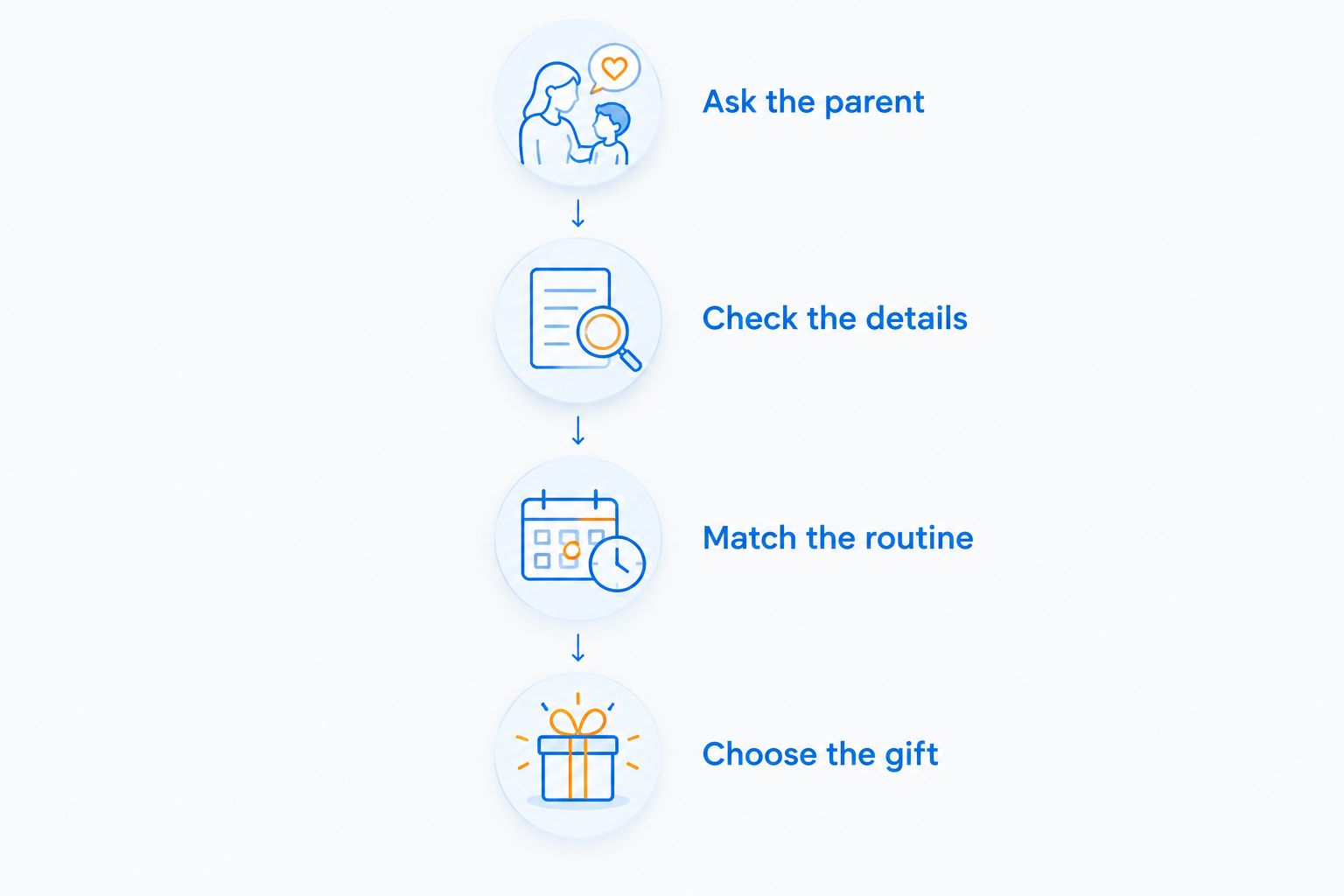
Use this sequence to move from a broad idea to a gift the family actually wants. Ask first, check the details, then decide whether the pillow belongs in the routine.
- Ask the parent. Find out whether a pillow is welcome, what the child enjoys, and whether the family has any requirements for materials or care.
- Check the details. Read the product's stated age guidance, intended use, materials, dimensions, and cleaning instructions. Confirm anything that determines whether you can give it confidently.
- Match the routine. Ask whether the child would use it during a story, a seated wind-down activity, or another parent-approved moment.
- Choose the gift. Select the pillow only when its confirmed details fit the recipient. Otherwise, choose a different kind of present rather than guessing.
Before buying, compare the gift approaches rather than assuming every bedtime present needs to be a pillow. These are general ways to give a gift, not claims that any particular product includes the activities or accessories described.
| Gift approach | Best for | Practical advantage | Trade-off |
|---|---|---|---|
| Pillow gift | A child whose parent confirms they enjoy a cozy buddy | Gives the child something to hold during an approved wind-down activity | Texture, size, and care requirements need checking |
| Animal coloring activity | A child who already enjoys coloring | Offers a screen-free activity you can share | Needs suitable supplies and a place to use them |
| Shared story time | A family that prefers experiences to extra belongings | Adds time together without requiring another soft item | Needs coordination with the family's schedule |
Which child are you buying for?
Start with the individual child, not an age-based stereotype. A younger sibling and an older sibling can enjoy very different gifts, even when both like the same animals.
Ask the parent to describe something the child already reaches for. A favorite soft toy, a preferred drawing activity, or a familiar story gives you a more useful starting point than a broad label such as sensory.
Ask about touch without turning it into a diagnosis
You can ask whether the child likes holding soft objects and whether there are textures they avoid. Keep the conversation ordinary and specific. You do not need to ask for private health information to choose a thoughtful present.
Do not assume that a sensory pillow is appropriate because a child has a particular diagnosis. Choose from the child's expressed preferences and the parent's guidance, not a claim that the gift treats a condition.
Let the parent handle age suitability
Check the manufacturer's stated age guidance for the exact item. A product photograph, an animal design, or the word kids does not establish an age recommendation.
For an infant, keep pillows and other soft objects out of the sleep space. A gift intended for an older child is not automatically suitable for a younger sibling, and a gift's bedtime theme does not make it appropriate for use during sleep.
Give an older child a say
If a surprise is not essential, invite the child to express a preference before you buy. You can keep the wrapping and delivery a surprise while confirming whether they actually want a pillow.
Offer 2 gift choices rather than an open-ended shopping assignment. For example, ask whether they would prefer a cozy companion or an animal coloring activity, then check the chosen item's suitability with their parent.
What should you check before buying a sensory pillow?
Use a short checklist for your 2026 purchase. The aim is not to find the longest feature list; it is to avoid choosing an item whose practical details conflict with the family's needs.
- Age guidance: Confirm that the exact product is intended for the recipient's age.
- Intended use: Distinguish holding a pillow during an activity from placing it in a sleeping space.
- Materials and texture: Check the stated materials and ask whether those suit the child.
- Dimensions and storage: Compare the listed size with the space the family wants to use.
- Care instructions: Check how the item should be cleaned and whether that suits the household.
- Gift policies: Read the current policy before buying if the family might need to exchange the item.
Do not turn an unanswered question into an assumption. If cleaning method or dimensions determine whether the present works, confirm those details before ordering.
Ask 3 practical questions: Does the child want this kind of gift? Does the product's guidance fit the child? Can the family comfortably use and care for it? Those questions are more useful than a long list of possible bedtime benefits.
Where does Comfort Calm Pillow fit?
Fill Joy is best for gift shoppers seeking a soft, cozy buddy for a child's wind-down routine. Its Comfort Calm Pillow is described as a soft, cozy buddy for a child to hug when it is time to wind down.
That makes it a relevant option when the parent confirms that the child enjoys holding a soft companion. Choose it for that straightforward role, not because the product name guarantees calm or better sleep.
- Best for: A child whose parent wants a cozy buddy for an age-appropriate wind-down activity.
- Pro: The stated purpose matches a simple gift idea: something soft to hug.
- Con: You still need to confirm age guidance, dimensions, materials, and care requirements against the recipient's needs.
- Decision: Choose it when the confirmed details fit; choose another gift when they do not.
For a 2026 present, assess Fill Joy's sensory pillow against the same checklist you would use for any other gift. A clear product purpose is helpful, but it does not replace the parent's judgment about suitability or sleeping arrangements.
Why sensory pillow gift suitability varies
A pillow can be a thoughtful present for one child and the wrong choice for another. These differences matter more than whether the gift looks appealing in a photograph.
- Personal preference: A child who wants a soft buddy has a different starting point from a child who prefers drawing.
- Age guidance: The exact product's stated guidance determines which recipients you should consider it for.
- Use setting: A supervised story-time companion and an object placed in a bed are different uses.
- Household care needs: Cleaning instructions need to fit what the family is comfortable doing.
- Available space: A gift needs somewhere to live when the child is not using it.
- Parent preference: Some families welcome another soft item; others would rather receive an activity or shared experience.
A mismatch is a reason to change the gift, not persuade the family. If the parent prefers a coloring activity or a story together, that answer makes your choice simpler.
Can you make the gift feel personal without adding more things?
Yes. A short note explaining why you thought of the child can be more personal than extra accessories chosen without their parent's input.
Mention an interest you genuinely know they have, such as animals or stories. Avoid writing that the present will stop worries, fix bedtime, or help the child sleep; those promises place expectations on both the child and the gift.
You can also offer to share a parent-approved activity when you give the present. Sit together for a story or let the child show you where their new buddy belongs. Leave the choice with them rather than requiring an immediate performance of gratitude.
Keep packaging straightforward, and give care information to the adult. A beautiful presentation is optional; knowing how to use and look after the gift is practical.
How can a sensory pillow fit into a screen-free evening?
A sensory pillow can be an optional companion during a parent-approved, awake activity. Suggest a place for it in the existing evening rather than introducing a separate routine the family must maintain.
Start with 1 optional activity: reading a story together, talking about a favorite animal, or coloring at a suitable surface. If the child wants to hold the pillow while listening, that can be their choice; if they put it aside, the gift has not failed.
Keep coloring supplies separate from the sleeping space and put them away when the activity ends. Follow the parent's plan for where the pillow belongs afterward. Screen-free time does not need to become an elaborate project or a promise of better sleep.
Should you give a pillow or an animal coloring book?
Choose the pillow when the child wants a soft companion and its confirmed guidance fits. Choose an animal coloring book when the child enjoys coloring and the parent welcomes that activity.
Neither option is automatically better for bedtime. A coloring activity asks the child to participate, while a cozy buddy can simply be present during an approved activity. Ask which kind of gift the child would enjoy rather than assuming a larger bundle is more thoughtful.
If you're considering Fill Joy for a bedtime gift, choose the item that matches that answer. You do not need to add another product to make the present feel complete.
Is it better to surprise the child or ask first?
Ask first when suitability depends on preferences you do not know. A parent can confirm whether the gift is welcome without revealing the exact present to the child.
For an older child with strong preferences, a direct question can be part of the gift-giving. The surprise can be how you present it, not whether you guessed correctly about what they want.
FAQ
What's the best way to choose sensory pillow gifts?
Choose sensory pillow gifts by checking the child's preferences, the exact product's age guidance, and the parent's intended use. Confirm materials, dimensions, and care instructions before buying.
Is a sensory pillow a good bedtime gift?
A sensory pillow is a suitable gift when the parent confirms that the child wants a soft companion and the product fits their requirements. Do not promise better sleep or assume that bedtime use means it belongs in a sleeping space.
What age is a sensory pillow suitable for?
Use the exact product's stated age guidance rather than a general age recommendation. Keep pillows and other soft objects out of an infant's sleep space.
Is Comfort Calm Pillow a weighted pillow?
Do not assume Comfort Calm Pillow is weighted from its name. Its supplied description identifies a soft, cozy buddy to hug; confirm any additional construction details before buying.
Should I choose a pillow or an animal coloring book?
Choose a pillow for a child who wants a soft companion, or an animal coloring book for a child who enjoys coloring. Check the parent's preferences and each item's suitability before deciding.
Do sensory pillow gifts treat anxiety or sensory conditions?
Do not choose a sensory pillow gift as a treatment for anxiety or sensory conditions. Give it for an ordinary, confirmed purpose, such as an age-appropriate cozy companion during a wind-down activity.
What should I include with a sensory pillow gift?
Include the product's care information and a personal note if you want one. Extra accessories are optional, and a single well-chosen gift is enough.
One last thing
Before wrapping a sensory pillow gift in 2026, decide who gets the instructions. Give the care and use information to the parent, even if the child opens the present first.
Then let the child decide whether the gift needs an introduction, a name, or simply a place beside their next story. A thoughtful gift offers a choice; it does not assign a bedtime job.